



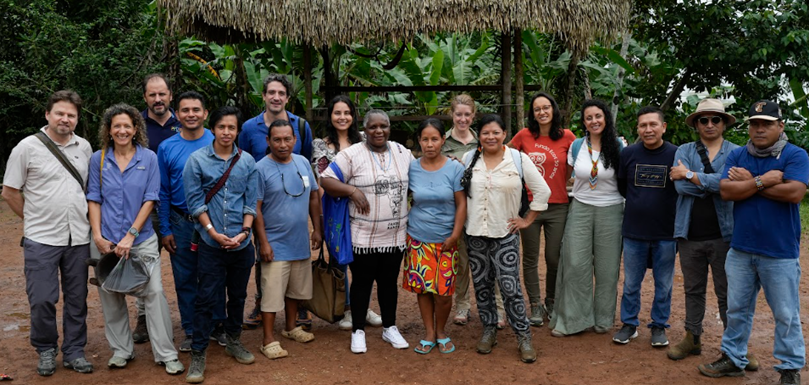
Through the Global Support Initiative to Indigenous and Community Conserved Areas (ICCA-GSI), the Global Environment Facility’s Small Grants Programme (SGP), implemented by the United Nations Development Programme ((UNDP), hosted a regional workshop for innovative financing for Indigenous Peoples and Local Communities (IPs and LCs) in Panama from 26-29 May 2025. The workshop was held in collaboration with the Biodiversity Credit Alliance (BCA) and its community advisory panel, the International Environmental Guardianship (IEG). The partnership provided a platform for multi-level actors from the region to explore new financing solutions for IPs and LCs. The participants included Indigenous leaders, representatives from Terrasos, Development Bank of Latin America and the Caribbean (CAF), Red de Mujeres Indígenas sobre Biodiversidad (RMIB-LAC), Fundación Indígena FSC, Organización de Mujeres Indígenas Unidas por la Biodiversidad de Panamá (OMIUBP), UNDP and SGP National Coordinators from Belize, Brazil, Colombia, Mexico, and Panama.
The BCA, hosted by the UNDP Biodiversity Finance Institute (BIOFIN), was launched during the Convention on Biological Diversity (CBD) COP 15 with support from UNDP, the United Nations Environment Programme Finance Initiative (UNEP FI), and the Swedish International Development Cooperation Agency (Sida). As a voluntary international alliance, BCA brings together diverse stakeholders to support the realization of the Global Biodiversity Framework, particularly Targets 19 (c) and (d). Central to BCA’s approach is the IEG’s community advisory panel, which consists of 40 representatives from seven global socio-cultural regions. This panel ensures that biodiversity credit systems are grounded in equity, human rights, and traditional knowledge.
The workshop featured three key themes that allowed participants to share valuable insights. These themes included:
(i) Biodiversity Credits: Navigating Risks, Unlocking Potential, Ensuring Good Governance
The risk with biodiversity credits is that they are still in early development and therefore, lack a universal definition or framework. To address this, the BCA initially introduced the High-Level Principles on Integrity of Biodiversity Credits in 2025. However, there is concern that these credit markets could mirror the flaws of carbon markets, resulting in the exclusion of local communities and the prioritization of profit over conservation. In order to prevent this, certain key principles must be upheld including (i) ensure Free, Prior, and Informed Consent (FPIC), (ii) enable direct financing for IPs and LCs, and (iii) shift incentives toward community-led conservation and sustainable development — rather than speculative markets.
(ii) Technology, Monitoring, and Data Sovereignty
Innovative technologies are reshaping environmental monitoring, especially when co-developed with Indigenous communities. The XPRIZE Rainforest initiative, for example, demonstrates how cutting-edge tools in AI, drones, sensors, and locally managed platforms can support continuous, context-sensitive biodiversity monitoring. Their approach focuses of data sovereignty, ensuring that Indigenous groups control how data is collected, stored, and shared. Traditional knowledge is integrated as valid science and thus, enriching the conservation efforts. The shift from “data governance” to “governance for data” helps define ethical frameworks before data collection processes begin. However, concerns remain about digital exploitation and the commodification of Indigenous data. Therefore, speakers underscored the importance of strong safeguards and community-led control.
(iii) SGP National Coordinators – Field Insights
SGP National Coordinators including Mr. Leonel Requena (Belize), Ms. Terena Peres (Brazil), Ms. Ana Beatriz Barona (Colombia), Mr. Sebastien Proust (Mexico), and Ms. Beatriz Schmitt (Panama) shared valuable insights drawn from their direct engagement with IPs and LCs. They emphasized the need for direct, flexible financing mechanisms to help IPs and LCs access international resources. They highlighted the need to strengthen local capacities and legal frameworks that support community-led governance. Successful models in countries like Brazil, Mexico, and Panama demonstrate the value of adaptive grant making as well as the recognition of Indigenous knowledge as a foundation for biodiversity management. Additionally, they advocated to expand South-South learning networks to foster peer exchange, innovation, and solidarity across the Global South.
Together, these insights form a compelling case for rethinking how biodiversity finance and governance are structured, placing communities at the centre, respecting their knowledge, and empowering them with the tools and resources to lead.

Strategic Outcomes for Regional and National Biodiversity Credit Initiatives
As part of their evolving collaboration, the SGP (through the ICCA-GSI), IEG, and BCA proposed a multi-tiered approach to advance biodiversity credit systems and nature market mechanisms in Latin America by forming strategic links to South Africa.
The proposed approach includes projects at both regional and local levels. A regional strategic project envisions supporting pilot countries in Latin America with cross-regional learning from South Africa. At the country level, participating countries will be encouraged to launch at least one pilot project focused on biodiversity credits at the community level. The goal is to strike a balance between local action and direct investment, while building practical understanding of nature markets and exploring early opportunities for income generation.
The partnership, guided by core principles and safeguards at both regional and national levels, commits to protect community rights throughout every stage of project development and implementation. Projects must deliver tangible, practical benefits to communities rather than merely consuming resources. Additionally, IEG will lead the community engagement process to ensure that Indigenous perspectives are central to the design and execution of all activities.
Next Steps: Advancing Biodiversity Credits and Nature Markets
The participants agreed on several key actions to build on the outcomes of the workshop and enhance collaboration among partners: host a follow-up review meeting with key partners as well as BCA, IEG, and SGP to agree on the next steps; SGP NCs work with IEG to design and submit at least one pilot proposal per country in 2025; draft a regional strategic project to support pilot implementation in Latin America and facilitate coordination with other regions; IEG Chair in Liberia to convene a dedicated meeting to assess the current status of nature markets and explore synergies with the Nature Markets Accelerator being developed by Conservation International.
Furthermore, a joint initiative known as the “8 Billion Hour Pledge” (8BH) will aim to measure the contributions of IPs and LCs to nature stewardship and identify mechanisms for compensation through new partnerships. 8BH is a partnership led by UNDP, BCA, and IEG, and together, they will pursue high-level government engagement to advance the initiative. Finally, a follow-up workshop focused on Africa will be organized on the margins of the G20 Summit in South Africa in November 2025, bringing together IEG, UNDP, SGP, and other partners to address biodiversity credits and nature markets in the African context.
Wrap-up and Excursion
On the last day of the workshop, a field trip to the Emberá Purú community in Gamboa area was organized where participants were able to engage and speak with Indigenous authorities including Elvira Cabrera, Noko (Chief), and Caisamo Marcial from the community council. Finally, for the closing session of the workshop, a visit to the Panama Rainforest Discovery Center was held, offering participants insight into the region’s biodiversity monitoring and conservation efforts.