



The community of Culta is part of the Ácora district in the southeastern part of Peru, near the border with Bolivia, along the western shores of Lake Titicaca. It is located more than 3,800 metres above sea level, in the province of Puno. It is also the home of Pascuala Pari and her fellow members of the Sumaq Chuyma Association, who have embarked on a resilient path to address the effects of climate change in the district. Through organizing and generating innovative solutions, they have not only recovered and conserved their agrobiodiversity, but also improved their livelihoods.
“This year, the rain and frost ruined all our crops... Then came the drought and took everything.”
- Pascuala Pari, leader of the Sumaq Chuyma Association
Extreme fluctuations in rainfall as a consequence of the climate crisis have significantly affected agriculture and the livelihoods of communities in this region. In 2024, due to low rainfall, Peru’s national weather service recorded a 42 cm drop in the water level at Lake Titicaca. The drought also affected the planting of grain, production of forage to feed animals, and water access. Pascuala remembers: “It was not like this before, the climate has changed a lot. We no longer have full water springs, there is less water.”
Like Pascuala, other Aymara leaders in the district are concerned about the future of the life they once knew. Although Peru is known for its agrobiodiversity (70 percent of food products consumed in the country come from smallholder farms), it currently faces a severe agricultural crisis affecting both the economy and food security of vulnerable high-Andean communities. According to the National Centre for Disaster Risk Estimation, Prevention, and Reduction (CENEPRED), Puno is the region with the highest frost risk, with nearly one million hectares of farmland at very high risk.
Sowing with Memory
To transform this situation, organizations like those led by Pascuala and Fanny are working to conserve their agrobiodiversity and secure food sources for the future. A key example of these community efforts are the seed banks they now lead.
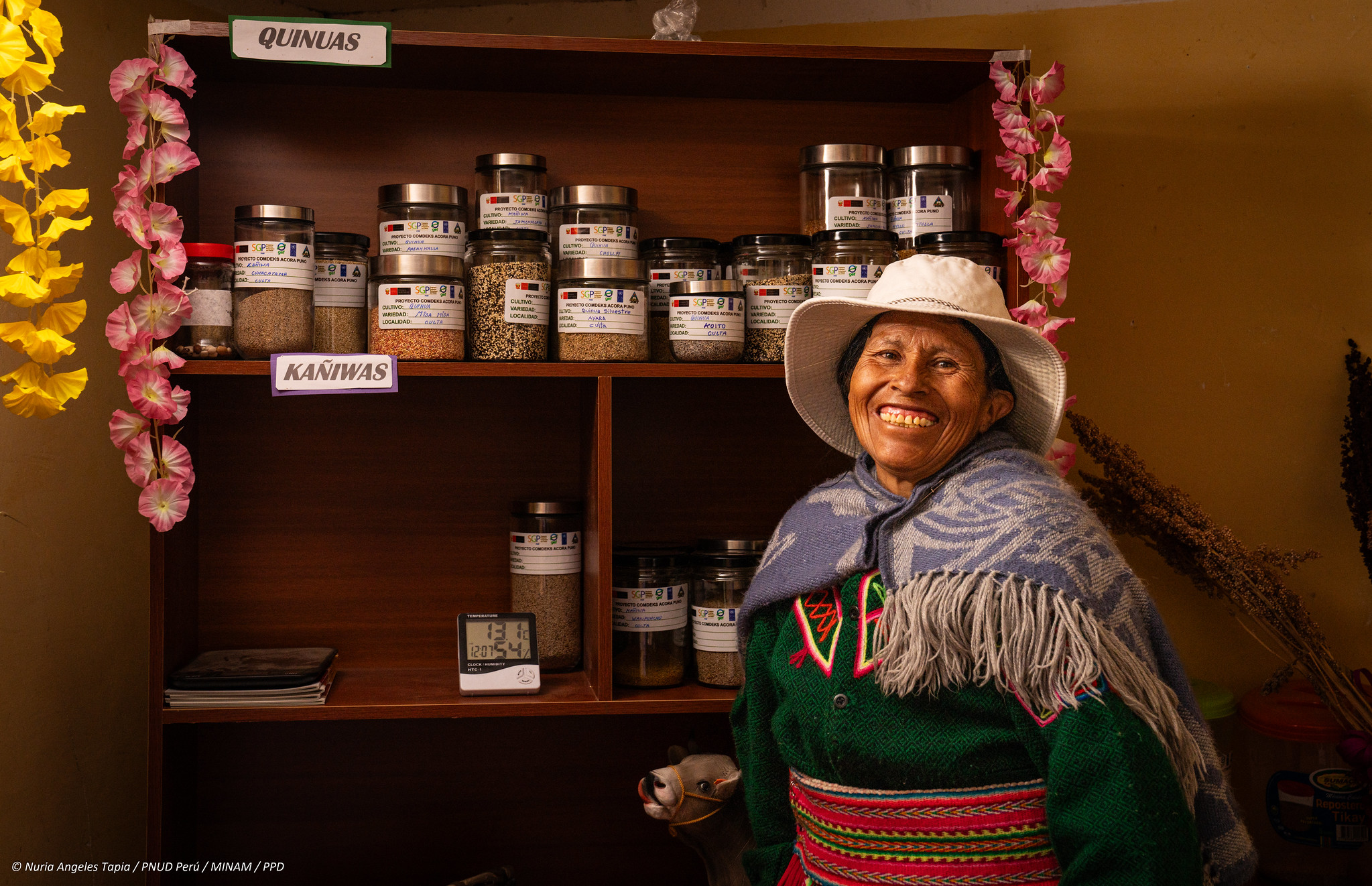
According to a recent report from the United Nation’s Food and Agriculture Organization (FAO), 17.6 million people in Peru face moderate or severe food insecurity. In this context, solutions like seed banks are vital. These are places where endemic and heirloom grain and tuber seeds are preserved to ensure that they are available for the future. Seed banks can be family- or community-based. “I am happy with my little seed bank, learning how to rescue cañihua [an heirloom crop related to quinoa], potatoes, oca [a traditional root vegetable]... now I have all kinds of quinoa: black, red, white. This supports me economically because I preserve and sell my products at local markets,” says Pascuala.
These banks help recover ancient seeds lost due to market pressures and climate change. They also enable seed exchange within and beyond the community. In Ácora district, 125 varieties of six native crops are being recovered and conserved across more than 1,250 hectares. Women like Pascuala and Fanny play a vital role in preserving these native seeds, which have fed their communities for generations and represent true treasures of biodiversity and culture.
Innovating to Conserve
The initiative in Ácora is currently driven by 11 community-based organizations, with technical support from the Institute for Rural Education and Innovation (Juli), which has adopted a participative approach to develop and implement diagnostic tools and an overarching strategy for landscape resilience. These efforts are supported by the Global Environment Facility (GEF) Small Grants Programme (SGP) and led by the Ministry of Environment (MINAM), with technical assistance from the United Nations Development Programme (UNDP), under the Community Development and Knowledge Management for the Satoyama Initiative Programme (COMDEKS).